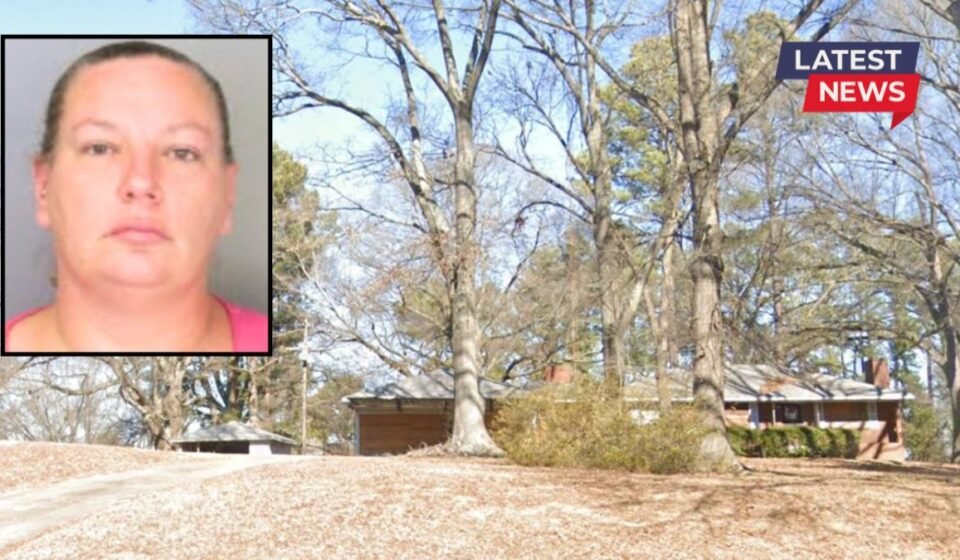
Mom tried to help her son get away with murder after he shot a guy in the head, kept his body inside of garage: Police

The unconditional bond between a parent and a child is often celebrated as one of humanity’s most noble traits. However, when that maternal instinct is warped to shield a killer from justice, the results are deeply unsettling. In a chilling case that recently unfolded in Memphis, Tennessee, law enforcement uncovered a horrific series of events involving a mother who actively conspired to help her juvenile son escape accountability for a brutal homicide.
The investigation exposed a dark narrative of a young man shooting a victim directly in the head, concealing the decomposing body inside an abandoned, detached garage, and a mother working frantically behind the scenes to destroy evidence and coordinate a potential international escape.
The Disappearance and Grim Discovery
The nightmare began in late October 2025, when a local Memphis man named Robert Groves suddenly vanished. Desperate for answers, his family initiated their own search after growing increasingly frustrated by the lack of immediate breakthroughs. Their initial breakthrough was alarming: they located Groves’ abandoned vehicle parked at an apartment complex in North Shelby County. Upon inspecting the vehicle, the family discovered blood inside, confirming their worst fears that foul play was involved.
Refusing to let the trail go cold, Groves’ family managed to obtain cellular data linked to his missing timeline and provided the digital breadcrumbs directly to law enforcement. Armed with this critical information, the Memphis Police Department, alongside officers from the Memphis Safe Task Force, localized their search.
On November 2, 2025, investigators converged on a property in the Frayser neighborhood of Memphis. Tucked away on the lot was an old, detached garage. When officers breached the structure, they discovered the badly decomposed body of Robert Groves. A subsequent medical examination confirmed the cause of death: a single, execution-style gunshot wound directly to the head.
Tracking the Digital Blueprint
With the victim’s body recovered, investigators turned their full attention to finding the killer. The Federal Bureau of Investigation’s Cellular Analysis Survey Team (CAST) was brought in to assist local homicide detectives. By analyzing the geographical movements of cell phones active around the time of Groves’ disappearance, analysts hit a massive breakthrough.
A mobile device uniquely associated with a local teenager—whose identity has been withheld by authorities due to his status as a juvenile—showed a digital footprint that perfectly mirrored the crime. The teen’s phone pinged continuously along the exact route between the location where Robert Groves was believed to have been killed, the North Shelby County apartment complex where the blood-soaked car was abandoned, and the detached garage in Frayser where the body was hidden.
For months, police quietly built their case while tracking the movements of the primary suspect. On April 29, 2026, law enforcement finally moved in, locating the teenager at Raleigh-Egypt High School, where he was enrolled as a student. He was taken into custody for questioning. However, according to police affidavits, the youth immediately invoked his legal rights and refused to speak with investigators.
When detectives confiscated the phone the teenager had on his person at the high school, they noticed an immediate discrepancy: it was an entirely different make and model from the device tracked on the night of the murder. The original phone, which contained the primary physical metadata of the homicide, was completely missing.
The Mother’s Intervention
As investigators dug deeper, they realized the suspect wasn’t operating alone. The teenager’s mother, Bridgit Riley, had allegedly stepped in to manage the fallout of her son’s lethal actions.
The breakthrough implicating Riley came from a routine audit of local correctional communications. On the very same day her son was detained at his high school, Riley placed a call to an inmate housed in a local Memphis jail. Unbeknownst to her, all inmate calls are recorded and monitored by law enforcement.
During the recorded conversation, Riley explicitly discussed her son’s legal jeopardy and the highly incriminating data tied to his mobile device. According to the police affidavit, Riley openly admitted that the teenager’s original phone contained clear photographic evidence of him sitting inside the deceased victim’s vehicle. Rather than urging her son to cooperate or contacting an attorney to handle the matter legally, Riley was recorded outlining a plan to permanently destroy the phone and mapping out logistics to flee the United States for another country to avoid prosecution.
Jailhouse Disclosures and the Destroyed Phone
This was not the first time Riley had used jail phone systems to coordinate a cover-up. Investigators retroactively pulled phone logs from February 2026, a period during which the juvenile suspect was being held in a juvenile detention facility on an entirely separate, unrelated charge.
The historical call logs revealed a series of conversations between Riley and her incarcerated son detailing the exact whereabouts of the “murder phone”. In these calls, the teenager instructed his mother to pass the compromised device to an associate identified only as “Jamarion” to get it out of their residence. Riley actively complied with her son’s requests.
Further digital forensics exposed the exact fate of the evidence. On February 13, 2026, Riley informed her son over a jail call that she was establishing a brand-new iCloud account and Apple ID for a replacement phone she had purchased for him. Armed with this timeline, police secured a search warrant for the newly created iCloud account.
The text messages recovered from the cloud storage provided the smoking gun. On the exact day the account was activated, a text message was sent through the account explicitly stating: “I just set him up a new Apple ID on this new phone. That other phone gon get smashed and throwed inda MS river.”
This exchange proved to prosecutors that Riley was not a passive observer or a grieving mother paralyzed by shock. Instead, she was an active coordinator in the systematic destruction of evidence, ensuring that the primary physical tracking data and photographic proof of the homicide were destroyed or thrown into the Mississippi River.
Arrest and Legal Repercussions
On Monday, July 6, 2026, the Memphis Police Department officially arrested Bridgit Riley. The state leveled severe charges against her, including tampering with fabricated evidence and acting as an accessory after the fact to first-degree murder.
Following her booking, Riley was held on a modest $10,000 bond and scheduled for an explicit bond review hearing on Wednesday, July 8, 2026. The community and extended family of Robert Groves have expressed outrage over the relatively low bond amount, given her recorded admissions regarding fleeing the country to avoid the reach of American law.
The case highlights a disturbing trend within modern criminal justice investigations where family networks act as insular protective rings, utilizing digital communication and physical destruction to actively impede homicide investigations. While a mother’s instinct to protect her offspring is a fundamental human drive, the law draws a hard, unyielding line when that protection manifests as concealing a body in a garage, destroying forensic evidence, and attempting to obstruct justice for a victim shot in the head.
As the legal proceedings against Bridgit Riley move forward in Shelby County court, the search for absolute closure continues for the family of Robert Groves, who are left to grapple not only with his violent death, but with the calculated lengths to which a mother went to keep his killer free.