70-year-old woman on ‘daily’ morning walk approached and shot 3 times in the back by random man at bus stop: Police

The tranquility of a routine summer morning in Central Florida was shattered on June 8, 2026, when a random and unprovoked act of violence targetless against the most vulnerable struck a quiet residential neighborhood. A 70-year-old woman, executing her daily ritual of a morning walk, was violently ambushed and shot three times in the back at a public bus stop. The sudden eruption of violence in Orlando’s Azalea Park community triggered a massive multi-jurisdictional manhunt, culminating in an interstate arrest by federal authorities and a subsequent legal battle that has left the local community shaken.
The tragedy unfolds a deeply unsettling reality regarding arbitrary public violence, the swift capabilities of modern neighborhood surveillance networks, and the complex process of bringing fugitives to justice across state lines.
The Ambush on Egan Drive
For the 70-year-old victim, whose identity has been withheld by authorities for safety and privacy reasons, Monday morning began precisely like countless others before it. A long-time resident of the Azalea Park area in Orange County, she was known to take regular walks through the suburban streets, a peaceful routine meant to maintain her health and enjoy the early, cooler hours of the day.
At approximately 9:00 a.m., her path took her along the 1000 block of Egan Drive, near the intersection of Hager Way. It was there, near a standard Lynx transit bus stop, that the routine turned catastrophic. According to subsequent investigative findings and court documents, the elderly woman noticed an unfamiliar man walking intentionally toward her. Sensing a strange presence, the woman instinctively sought to avoid interaction. She turned her body away from the stranger near the bus stop shelter, hoping to continue her walk undisturbed.
She did not have the chance. As she turned her back to walk away, the man drew a firearm. A witness situated directly across the street watched the horrific encounter play out in broad daylight. The bystander observed the suspect pass the victim, spin around to position himself directly behind her vulnerable frame, and open fire.
The initial gunshot struck the woman, sending her collapsing heavily onto the pavement. The attacker did not halt his assault upon seeing his victim fall. As she lay helpless on the ground, the gunman stepped closer and pulled the trigger two more times, deliberately discharging a total of three bullets directly into her back. Following the rapid succession of gunfire, the assailant fled the scene on foot, leaving the critically wounded octogenarian bleeding on the sidewalk.
Emergency medical personnel and Orange County Sheriff’s deputies rushed to the scene within minutes of receiving frantic 911 calls from neighbors. The victim was stabilized at the scene before being rushed to a nearby hospital in critical condition. She was immediately taken into emergency surgery, where trauma teams fought to save her life.
Suburban Standoff and the Digital Breadcrumbs
As medical staff monitored the victim’s touch-and-go status in the intensive care unit, detectives flooded Egan Drive to secure the physical evidence. At the immediate scene of the shooting, forensic technicians recovered three spent Hornady .380 caliber shell casings, a crucial initial clue regarding the weapon used in the assault.
Recognizing the completely random nature of the attack, investigators focused heavily on canvas intelligence. They began knocking on doors throughout Azalea Park, collecting digital evidence from modern home security ecosystems. The neighborhood’s residential ring cameras and smart doorbells proved invaluable. Detectives successfully pulled crisp surveillance video from multiple homes, mapping out the suspect’s movements before and immediately after the shooting. The footage clearly captured a young man wearing distinct black athletic shorts and sandals, wandering through the neighborhood streets in a manner that suggested he was looking for a target.
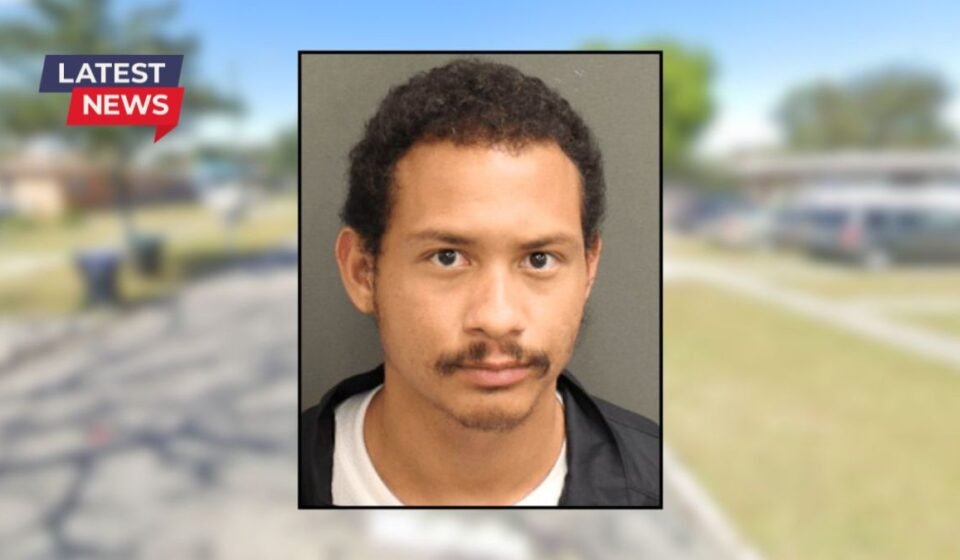
The breakthrough in identifying the shooter came from an unexpected civilian source. Law enforcement shared the collected surveillance footage with individuals tied to the local real estate market who were active in the neighborhood. A real estate agent connected to a property near the crime scene reviewed the video files and immediately recognized the individual. The agent identified the man in the video as 27-year-old Kevin Millares. Furthermore, the agent provided detectives with his residential address: 800 Faber Drive, a house located mere blocks away from where the elderly woman was shot.
Armed with this fresh intelligence, the Orange County Sheriff’s Office moved aggressively. A heavily armed SWAT team, accompanied by armored vehicles and K-9 units, descended upon the Faber Drive residence near Flanders Way on Monday afternoon. Law enforcement surrounded the perimeter, utilizing megaphones to command the occupants to exit. What followed was a tense, hours-long standoff that captivated local media, with flashing police lights cordoning off sections of the neighborhood.
However, when tactical teams finally breached the front door and cleared the interior of the home, they discovered that Millares was gone. He had managed to slip away from the immediate area before the police cordon was fully established.
Despite missing the suspect, the search warrant executed inside the Faber Drive home yielded damning physical evidence. Inside the kitchen, investigators discovered a loaded Hornady .380 caliber magazine alongside a box of matching ammunition—perfectly matching the brand and caliber of the three shell casings collected from the pavement where the victim fell. Moving to the master bedroom, detectives recovered a pair of black shorts and casual sandals that perfectly matched the attire worn by the gunman in the home security footage. The forensic link was firmly established, transforming Millares from a person of interest into a wanted fugitive accused of attempted capital murder.
The Interstate Flight and Arrest
With Millares actively fleeing, the local investigation quickly expanded into a federal manhunt. The Orange County Sheriff’s Office formally requested the operational assistance of the United States Marshals Service, leveraging their specialized fugitive recovery task forces. Investigators tracked digital signatures, communication lines, and travel routes, quickly realizing that Millares had abandoned the state of Florida entirely in a desperate bid to evade the law.
The interstate flight came to an abrupt halt weeks later in New York. Acting on coordinate data provided by Florida detectives, federal marshals and local New York law enforcement tracked Millares to a hiding spot. He was taken into custody without further incident, ending a multi-week period of anxiety for the residents of Azalea Park who feared the random shooter might return.
Extradition protocols were swiftly enacted, and Millares was transported back down the East Coast under armed guard. Upon his return to Central Florida, he was booked directly into the Orange County Jail, where he remains held as the legal machinery begins to turn.
Arraignment and the Fight for Pretrial Detention
The legal proceedings against the 27-year-old suspect advanced significantly in early July 2026. Court documents revealed that Kevin Millares formally entered a plea of not guilty to the charge of first-degree attempted murder with a firearm. Because the charge involves the intentional use of a firearm to commit an act that could have easily resulted in a loss of life, the state classifies it as a capital felony, carrying severe statutory penalties up to life imprisonment.
Recognizing the random, hyper-violent nature of the crime and the suspect’s immediate history of interstate flight, the state attorney’s office filed a motion for pretrial detention. Prosecutors are aggressively asking an Orange County judge to keep Millares locked behind bars without the possibility of posting bond until his official trial date. The state argues that Millares represents an extreme, unpredictable danger to the community at large and poses a significant flight risk, as demonstrated by his trek to New York. A judge is scheduled to issue a formal ruling regarding the defense’s bond request on Tuesday.
Meanwhile, the Azalea Park community continues to process the shock of the event. Neighborhood watch groups have vocalized heightened concerns over pedestrian safety and the vulnerability of seniors who utilize public transit systems. The victim’s ongoing recovery remains a central focus for neighbors, who have expressed profound relief that the digital vigilance of homeowners and swift action by federal authorities successfully removed the threat from the public sphere. As the court date approaches, the case stands as a stark reminder of the fragile nature of public safety and the critical role technology now plays in solving senseless crimes.