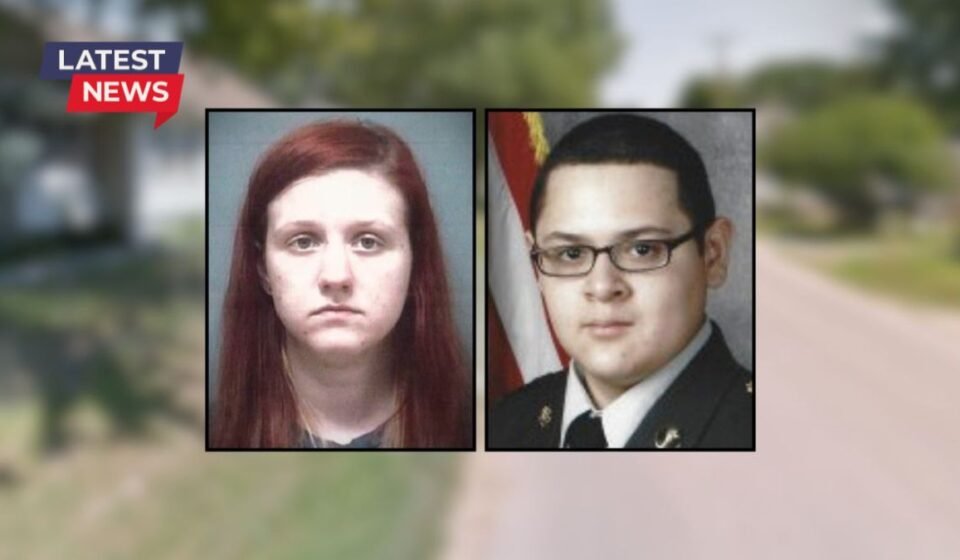
Cop shot her roommate dead after sending him Snapchat photos of her holding the gun to her head: Authorities

The thin line separating a calculated crime from a tragic accident often vanishes in the dark hours after midnight. In the early morning of March 10, that line blurred completely inside a home on Roosevelt Street in Creve Coeur, Illinois. When the gunsmoke cleared, a 29-year-old man lay dying on a hallway floor, and the woman trying to revive him was not just his roommate, but a local police officer.
What initially began as a frantic 911 call reporting a self-inflicted tragedy quickly unraveled into a first-degree murder investigation. At the heart of the case is Caitlynn Girkin, a 27-year-old officer with the Creve Coeur Police Department, now accused of shooting her roommate, Adolfo Cazares, to death. But it is the evidence uncovered on a social media app in the minutes leading up to the muzzle flash that has transformed a grim local shooting into a haunting tale of digital breadcrumbs and shifting narratives.
The Midnight Call and Changing Stories
Just before 2:15 a.m., dispatchers received an emergency call from an off-duty Girkin. She was panicked, stating that her roommate had gotten hold of her personal firearm and shot himself. When responding officers arrived at the scene, they found a chaotic, bloody environment. Cazares was unresponsive in the hallway just outside Girkin’s bedroom, bleeding heavily from his mouth, nose, and a single gunshot wound to the chest. Girkin was desperately performing CPR on him. Her service weapon sat quietly on her bed nearby.
Emergency medical personnel could do nothing to save Cazares; he was pronounced dead right there on the hallway floor. Because the suspect was an active-duty police officer, the local department immediately handed the reins of the investigation over to the Illinois State Police to ensure objectivity.
It didn’t take long for the official narrative to fracture. During her very first interview with state investigators on the day of the shooting, Girkin claimed she was lying in bed when Cazares walked into her room carrying her gun. Fearing he was about to commit suicide, she claimed she lunged forward to wrestle the weapon away from him. In the ensuing struggle, she said, the gun “popped”. She told investigators that Cazares explicitly admitted he had shot himself before collapsing, and she noted that his sweatpants had fallen down as he hit the ground.
Yet, under continued questioning that same day, the details began to morph. Girkin altered her account, suggesting that Cazares had entered the room while actively pulling his sweatpants down with one hand and holding the gun with the other. She then claimed she managed to gain full control of the firearm during the struggle and fired the fatal shot herself.
The Digital Blueprint
As state detectives began digging into the digital footprints left behind by both roommates, they discovered a disturbing prelude to the violence. The physical evidence simply did not square with the story of a sudden, unpredictable bedroom intrusion.
Investigators discovered that in the minutes leading up to the shooting, Girkin had been active on Snapchat, sending direct messages to Cazares while he was in another part of the house. These weren’t casual late-night texts. According to the probable cause affidavit, Girkin had sent Cazares a photo of herself holding her handgun directly to her own head.
Moments later, she followed up the photo with a video. In the brief recording, sent just before Cazares walked into her bedroom, Girkin went a step further, placing the barrel of the loaded firearm inside her mouth.
When confronted by investigators about the social media activity during a second interview more than a month later, Girkin admitted to sending the photo of the gun to her head. However, she claimed she could not recall sending any subsequent videos, despite the digital evidence recovered by forensic teams.
The discovery of the Snapchat messages fundamentally altered the timeline and the context of the shooting. It suggested a volatile, high-stakes emotional environment rather than a random, unprovoked confrontation. It also directly contradicted Girkin’s initial assertion that Cazares had brought the weapon into the room to harm himself.
A Final Admission
By late April, the weight of the digital evidence and the autopsy results—which ruled the death a homicide caused by a close-range shot to the chest—forced another rewrite of the evening’s events. On April 23, state police sat down with Girkin for another formal interview.
This time, the former officer abandoned the story about a struggle over a weapon that Cazares had brought into the room. Instead, she admitted that her personal handgun had been sitting on her nightstand the entire time. She claimed that Cazares entered her room, began pulling down his sweatpants, and reached out to touch her leg.
In this new version, Girkin stated she slapped his hand away, grabbed the gun from her nightstand, and pointed it at him. According to court documents, Cazares saw the weapon, realized the danger, and pleaded, “Don’t shoot me.” Girkin claimed she tightened her grip on the weapon and it discharged as he moved toward her, asserting she acted out of fear of a sexual assault.
However, prosecutors quickly pointed out a glaring inconsistency: during her initial interview on the day of the incident, Girkin explicitly told detectives that she and Cazares had a history of consensual sexual relations and that he had made absolutely no aggressive advances toward her before the shooting occurred.
The Legal Aftermath
The fallout for Girkin was swift. Following the internal and state investigations, she was removed from the Creve Coeur Police Department, with Police Chief Justin Egan later confirming her status as a former officer.
In July, the Tazewell County State’s Attorney’s Office officially filed charges, booking Girkin into the county jail on three counts of first-degree murder. Appearing via video link for a brief initial hearing, Girkin informed the court that she bypassed the public defender’s office in order to retain private counsel. Her defense team requested a delay in her formal pretrial detention hearing, noting that they needed time to parse through more than 500 pages of police reports and hours of recorded interviews.
As she awaits her next day in court, the community is left grappling with the reality of an officer sworn to uphold the law now facing up to 85 years in prison for violating it in the most permanent way possible. What remains is a digital trail of frantic, late-night Snapchats—a permanent record of a chaotic escalation that ended a young man’s life and shattered a cop’s career in a single, irreversible second.