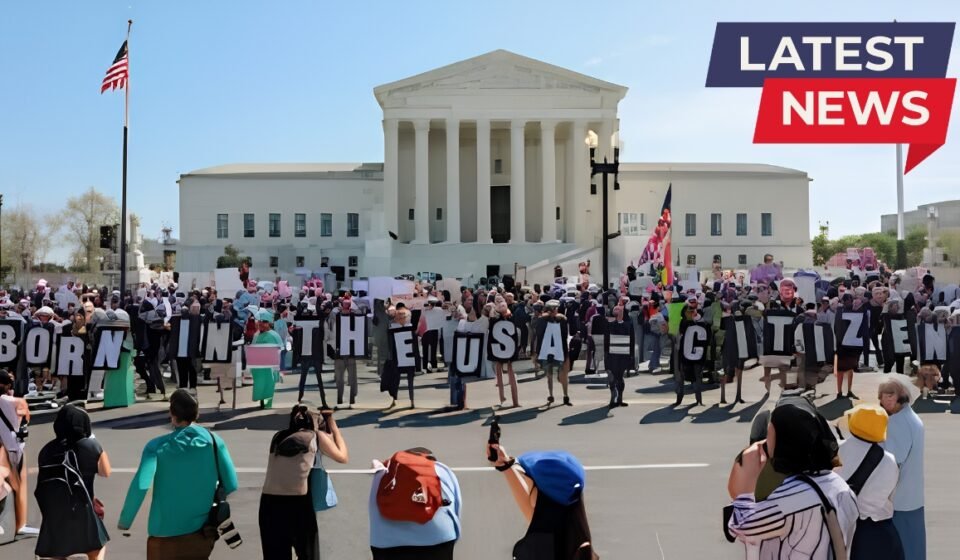

The United States Supreme Court is preparing to issue one of its most significant constitutional rulings in decades as it considers President Donald Trump’s effort to restrict birthright citizenship. The case has become a major legal, political, and constitutional battle that could affect immigration policy, citizenship rights, and the interpretation of the 14th Amendment for generations.
The decision will determine whether a U.S. president has the authority to limit automatic citizenship for certain children born in the United States through an executive order, or whether such a change would require a constitutional amendment or an act of Congress. The ruling is expected as part of the Court’s final decisions of the current term.
What Is Birthright Citizenship?
Birthright citizenship is the legal principle that grants U.S. citizenship to nearly every person born on American soil, regardless of their parents’ immigration status.
This principle comes from the Citizenship Clause of the 14th Amendment to the U.S. Constitution, ratified in 1868, which states:
For more than 150 years, this constitutional protection has been interpreted to grant citizenship to almost all children born in the United States.
Why Is This Case Before the Supreme Court?
Shortly after returning to office, President Donald Trump signed an executive order seeking to limit birthright citizenship.
Under the order, children born in the United States would no longer automatically become U.S. citizens if:
- Their mother is in the country illegally and their father is neither a U.S. citizen nor lawful permanent resident.
- Their parents are temporarily in the United States on visas and do not have permanent legal status.
The administration argues that these children are not fully “subject to the jurisdiction” of the United States as intended by the 14th Amendment.
Multiple federal judges immediately blocked the order, leading to a series of lawsuits that eventually reached the Supreme Court.
Trump’s Legal Argument
The Trump administration says the Constitution has been interpreted too broadly for decades.
Government lawyers argue that:
- The phrase “subject to the jurisdiction thereof” excludes children whose parents owe primary allegiance to another country.
- The 14th Amendment was primarily intended to guarantee citizenship to formerly enslaved people after the Civil War.
- Congress and previous courts expanded the amendment beyond its original meaning.
The administration believes the executive branch has authority to reinterpret how citizenship laws are enforced.
Arguments Opposing Trump’s Order
Opponents—including civil rights organizations, immigrant advocacy groups, and several states—argue that:
- The Constitution clearly guarantees birthright citizenship.
- A president cannot rewrite constitutional rights through an executive order.
- The Supreme Court already settled the issue over a century ago.
- Restricting birthright citizenship would create legal uncertainty for hundreds of thousands of children.
They also warn that ending automatic citizenship could leave many children stateless if they are not recognized as citizens by another country.
The Importance of United States v. Wong Kim Ark
The most important legal precedent in this case is United States v. Wong Kim Ark (1898).
In that landmark decision, the Supreme Court ruled that a child born in San Francisco to Chinese parents who were not U.S. citizens was nevertheless an American citizen under the 14th Amendment.
For more than a century, courts have relied on this decision to uphold birthright citizenship.
Trump’s legal team argues that the ruling should either be narrowed or reconsidered, while opponents say it remains binding constitutional precedent.
What Happened During Supreme Court Arguments?
The Supreme Court heard oral arguments earlier this year.
The hearing attracted national attention because President Trump attended part of the arguments, becoming the first sitting U.S. president known to attend Supreme Court oral arguments involving his own administration.
During questioning, several justices explored:
- Whether presidents have authority to reinterpret constitutional language.
- Whether lower courts properly blocked the executive order nationwide.
- Whether the Court should address only procedural issues or decide the constitutional question itself.
Observers noted that some justices expressed skepticism toward the administration’s constitutional interpretation while also questioning the broad use of nationwide injunctions.
What Is the Supreme Court Expected to Decide?
The Court could issue several different types of rulings.
1. Uphold Birthright Citizenship
The Court could determine that the 14th Amendment guarantees citizenship to virtually everyone born in the United States and declare Trump’s executive order unconstitutional.
This would preserve the existing interpretation that has existed for generations.
2. Allow Trump’s Executive Order
The Court could agree with the administration’s interpretation, allowing restrictions on automatic citizenship for certain children born in the United States.
Such a decision would represent one of the biggest changes to American citizenship law in modern history.
3. Issue a Narrow Procedural Decision
The Court could avoid fully deciding the constitutional issue and instead rule on whether lower courts had authority to issue nationwide injunctions blocking the executive order.
This could allow additional litigation before the constitutional question is finally resolved.
Why This Decision Matters
The ruling could have enormous consequences across the United States.
Potential impacts include:
- Changes to U.S. immigration policy.
- Citizenship eligibility for future children born in America.
- Federal and state government benefits.
- Passport issuance.
- Voting rights in future generations.
- Immigration enforcement policies.
- The balance of power between presidents and the judiciary.
Legal experts say the decision may become one of the most important constitutional rulings in decades.
Political Significance
The case is central to President Trump’s broader immigration agenda.
Throughout his political career, Trump has argued that birthright citizenship encourages illegal immigration and “birth tourism.”
Supporters believe limiting birthright citizenship would strengthen border security and discourage unauthorized immigration.
Critics argue the proposal conflicts with the Constitution and undermines long-established civil rights protections.
The ruling is expected to influence immigration debates well beyond Trump’s presidency.
Possible Impact on Families
If the executive order ultimately takes effect, some children born in the United States could lose automatic citizenship if their parents do not meet the administration’s eligibility requirements.
Families could face uncertainty involving:
- Citizenship documentation
- Passports
- Social Security numbers
- Access to federal programs
- Future voting eligibility
- Immigration status
Advocacy groups have warned that prolonged legal uncertainty could create significant administrative challenges for affected families.
Current Status
As of today, the Supreme Court is expected to release its ruling as part of the final decisions of its current term. Until the Court issues its opinion, existing court orders continue to shape how the executive order is enforced, and the outcome could redefine the legal landscape surrounding birthright citizenship in the United States.
Conclusion
The Supreme Court’s upcoming decision on President Trump’s attempt to limit birthright citizenship is poised to become a landmark moment in American constitutional law. At its core, the case asks whether the long-standing understanding of the 14th Amendment should remain unchanged or whether the executive branch has the authority to narrow who qualifies as a U.S. citizen at birth.
Whatever the Court decides, the ruling will have lasting implications for immigration policy, constitutional interpretation, executive power, and the rights of future generations born in the United States. Legal scholars, policymakers, and millions of Americans are closely watching the decision, recognizing that it could reshape one of the nation’s most fundamental constitutional protections.