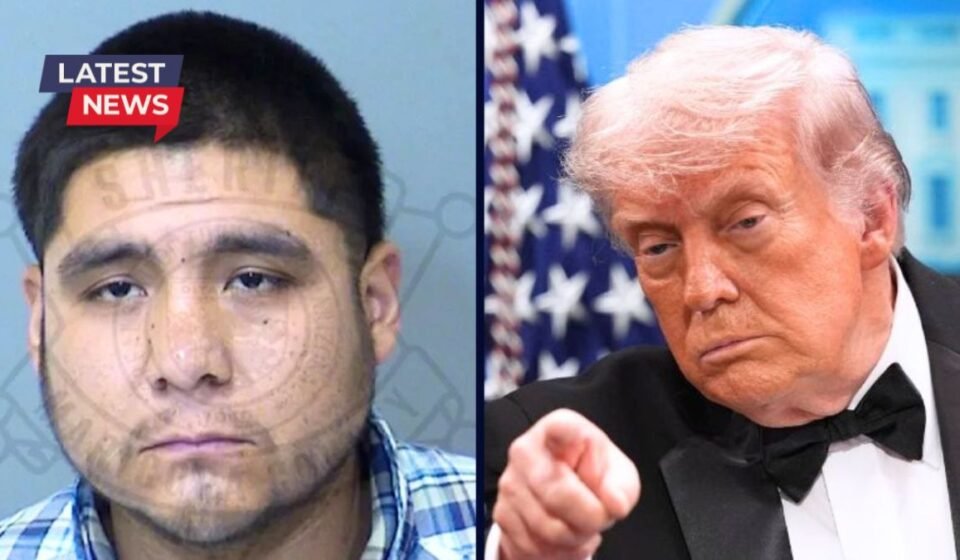

A digital threat turned into a swift reality for a 30-year-old Arizona man after law enforcement officers tracked him down for making explicit death threats against a prominent local official. What elevated this case from a standard cyber-harassment investigation into a bizarre national headline was the suspect’s public attempt to secure a preemptive presidential pardon.
Jose Angel Valadez was arrested by Maricopa County sheriff’s deputies following a series of alarming social media posts. In these posts, Valadez openly declared his intent to kill Maricopa County Sheriff Jerry Sheridan. Alongside the violent declarations, Valadez explicitly tagged the official account of former President Donald Trump, requesting “full presidential immunity” for the act he was planning to commit.
The incident highlights a growing and dangerous intersection between extreme political rhetoric, the misunderstanding of high-level legal concepts, and the immediate real-world consequences of utilizing digital platforms to threaten public servants.
The Digital Paper Trail and a Bold Request
The investigation began rapidly on July 1, 2026, when digital monitoring systems and public reports flagged a series of highly erratic and dangerous posts on the social media platform X (formerly known as Twitter). The user, identified by investigators as Jose Angel Valadez, published direct statements outlining a plot to take the life of Sheriff Jerry Sheridan.
Sheridan, a long-time figure in Arizona law enforcement who took over the reins of the Maricopa County Sheriff’s Office (MCSO) following a lengthy career in public service, was the sole target of the tirade.
While online threats against elected officials have unfortunately spiked across the United States in recent years, Valadez’s posts contained a striking novelty. Interspersed with the violent threats were direct appeals to Donald Trump. Valadez tagged Trump’s public handle, @realDonaldTrump, asking for a total legal shield. The suspect appeared to believe that if a political figure granted him “full immunity,” he would be entirely insulated from state and federal prosecution for committing murder.
Detectives with the Maricopa County Sheriff’s Office threat assessment team worked alongside cyber-intelligence units to trace the account’s digital footprint. Within hours of the initial posts, analysts confirmed Valadez’s identity and established his location within the Phoenix metropolitan area.
The Takedown and Formal Charges
Recognizing the volatile nature of the posts and the explicit mention of violence against the head of their agency, deputies moved quickly to execute an arrest. Later that same day, law enforcement units converged on Valadez’s location and took him into custody without any major operational complications.
Following his apprehension, Valadez was transported to the Maricopa County jail, where he was formally processed and booked. The Maricopa County Attorney’s Office reviewed the digital evidence and compiled a strict list of initial charges. Valadez currently faces multiple counts, including:
- Threatening and intimidating a public official.
- The illegal use of an electronic device to terrify, intimidate, or threaten.
Under Arizona law, utilizing a telephone, computer, or any internet-connected device to transmit threats of severe physical harm or death elevates standard harassment to a major felony category. Prosecutors have noted that the explicit nature of the writing, paired with a clear target, provides a substantial foundation for a aggressive prosecution.
Law Enforcement Responds to the Threat
Following the arrest, the Maricopa County Sheriff’s Office released a firm public statement outlining their stance on threats targeted at members of the government and the justice system. The department emphasized that political ideology, digital anonymity, and unusual legal theories would never alter the fundamental execution of police duties.
“The Maricopa County Sheriff’s Office enforces the rule of law without exception,” the agency stated in an official media release. “We will not tolerate threats, intimidation, or acts of violence against elected officials, law enforcement personnel, or any member of our community.”
Command staff within the department also praised the rapid response of the digital forensics team, noting that early intervention is the primary tool used to prevent online vitriol from manifesting as physical violence.
The Distortion of “Presidential Immunity”
Legal analysts and political experts have quickly pointed to this case as a prime example of how complex legal doctrines can be radically distorted when filtered through social media echo chambers.
The concept of “presidential immunity” has been a focal point of intense national debate, particularly following landmark Supreme Court rulings regarding the scope of executive power and what constitutes official versus unofficial presidential acts. However, legal scholars emphasize that presidential immunity applies strictly to the chief executive executing core constitutional duties while in office.
Furthermore, the United States Constitution grants the president the power to issue pardons and reprieves, but this authority is strictly limited to federal offenses. A U.S. President has zero constitutional authority to grant immunity or a pardon for state-level crimes, such as a local murder charge prosecuted under Arizona state law.
Valadez’s public request to Trump reflects a profound misunderstanding of the American legal structure. It suggests a dangerous belief that political alignment or a direct appeal to a powerful figure can override statutory criminal law and grant an individual a license to bypass the justice system entirely.
A Growing Pattern of Political Volatility
The arrest of Valadez is not an isolated incident but rather part of a broader, multi-year trend of heightened volatility targeting public officials in Arizona. Maricopa County, as one of the largest voting jurisdictions in the United States, has frequently found itself at the epicenter of intense political scrutiny, election conspiracies, and localized polarization.
Sheriffs, election workers, judges, and county supervisors in the region have been subjected to an unprecedented volume of hostile communications over the last several cycles. Law enforcement agencies across the state have been forced to allocate significant budgetary resources toward protective details, intelligence gathering, and advanced threat assessment software simply to ensure the physical safety of public servants doing their jobs.
National federal agencies, including the Federal Bureau of Investigation (FBI) and the Department of Homeland Security (DHS), have repeatedly issued bulletins warning that domestic violent extremists and radicalized individuals frequently utilize social media to broadcast their intentions before acting. The rapid apprehension of Valadez demonstrates that local law enforcement is taking a zero-tolerance approach to these warnings.
Next Steps in the Judicial Process
With Valadez currently behind bars, the focus shifts to the judicial system. Bail hearings and initial court appearances will determine whether the suspect remains detained pending trial. Given the explicit threat to the life of the county’s top law enforcement officer, prosecutors are highly likely to argue that Valadez represents a significant danger to the community and a flight risk, requesting a substantial bond or hold.
Defense attorneys will likely look closely at the suspect’s mental state at the time the posts were authored. Erratic online behavior that pairs extreme violence with highly unrealistic legal assumptions—such as expecting a former president to intervene via an internet tag—often prompts competency evaluations during the early phases of pretrial motions.
Regardless of the defense strategy, the Maricopa County Sheriff’s Office has made it clear that the digital trail left behind provides an open-and-shut case regarding the intent to terrify. The case will move forward through the Arizona Superior Court, serves as a stark warning to the public that what is typed on a keyboard carries severe, concrete real-world penalties.