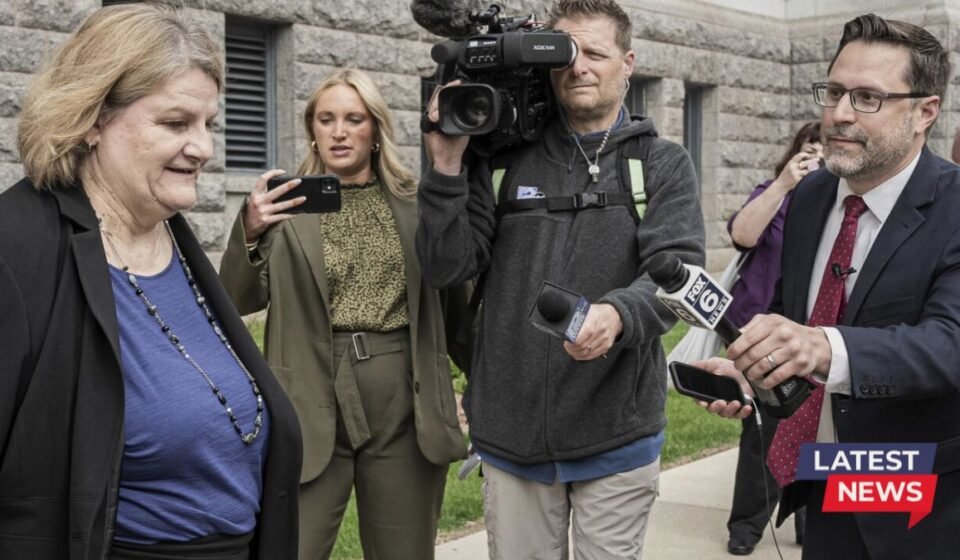

The intersection of local justice and federal immigration enforcement has long been a flashpoint for American politics, but few battlegrounds have proven as dramatic, or as deeply personal, as the courtroom of former Milwaukee County Circuit Judge Hannah Dugan.
In a decision that concluded one of the most highly watched federal trials involving a sitting member of the judiciary, U.S. District Judge Lynn Adelman ordered Dugan, 67, to pay a $5,000 fine. The sentence, handed down in a federal courtroom, spared the veteran jurist from prison time but cemented a felony conviction that has already shattered her career, forced her resignation, and transformed her into a polarizing symbol of the nation’s ongoing border wars.
The case marked the first time in Wisconsin’s history that a state judge faced a criminal trial for actively impeding federal immigration agents. For critics, Dugan’s actions were an egregious abuse of the bench—a rogue official using the prestige of her office to sabotage the rule of law. For supporters, she was a protector of courtroom decorum who fell victim to a highly weaponized federal apparatus designed to intimidate local authorities into submission.
The Moments of Deviation
The chain of events that culminated in Dugan’s downfall unfolded in a matter of minutes on April 18, 2025, inside the Milwaukee County Courthouse. On that spring morning, 31-year-old Eduardo Flores-Ruiz was scheduled to appear in Dugan’s courtroom for a hearing regarding a state misdemeanor battery case. Flores-Ruiz, a Mexican national, had previously been deported from the United States in 2013 and had reentered the country illegally.
Unbeknownst to the courtroom staff initially, plainclothes agents from U.S. Immigration and Customs Enforcement (ICE) had tracked Flores-Ruiz to the building. Armed with an administrative immigration warrant, the agents waited in the hallway outside Dugan’s doors, preparing to take Flores-Ruiz into federal custody once his state business concluded.
When Dugan became aware of the federal officers waiting outside, the atmosphere in the courtroom shifted from routine bureaucracy to high-stakes confrontation. Leaving her bench, Dugan directly confronted the ICE agents in the corridor. She challenged their authority within the state courthouse, asserting that an administrative warrant—which is signed by an immigration officer rather than a neutral judge—was insufficient to execute an arrest inside her domain.
Hoping to clear the hallway, Dugan directed the agents down the corridor to the office of the county’s chief judge to hash out the jurisdictional dispute. It was during those crucial minutes, while the majority of the ICE team was away from her doorway, that Dugan made the fateful choice that would end her career. Returning to her bench, she abruptly postponed Flores-Ruiz’s state hearing. She then ushered the defendant and his defense attorney out of the public eye, guiding them through a private backdoor normally reserved exclusively for jurors and court staff.
The escape was short-lived. As Flores-Ruiz emerged from the restricted areas of the building, waiting federal agents spotted him. Following a brief, chaotic foot chase just outside the courthouse steps, Flores-Ruiz was tackled, handcuffed, and taken into federal custody. He remained in federal detention until November of that year, when he was formally deported back to Mexico.
A Public Arrest and Political Firestorm
While Flores-Ruiz’s brief escape ended on the pavement outside the courthouse, the repercussions for Judge Dugan were only beginning. Roughly a week after the incident, FBI agents arrived at the Milwaukee County Courthouse with a federal arrest warrant. In a highly public display, Dugan was placed in handcuffs and escorted out of the very building where she had presided over law and order for nearly a decade.
The Department of Justice made no effort to minimize the spectacle. FBI Director Kash Patel prominently featured the arrest on social media, sharing images of the veteran judge in handcuffs as a stark warning. The message from federal prosecutors was unambiguous: the judiciary is not a sanctuary, and no individual, regardless of their robes, stands above federal law.
The political fallout in Wisconsin was instantaneous. Republican lawmakers in the state legislature immediately seized on the indictment, labeling Dugan an “activist judge” who had flagrantly violated her constitutional oath. Under mounting pressure and facing the very real threat of formal impeachment proceedings from state Republicans, Dugan announced her resignation from the Milwaukee County Circuit Court bench in January. In a pointed resignation letter, she warned that her federal prosecution represented a coordinated effort to “crush” the independence of the state judiciary and force local courts to act as arms of federal deportation campaigns.
The Trial and the Verdict
By December, the arguments moved from the court of public opinion into a federal courtroom. Throughout her trial, Dugan stoutly maintained her innocence. Taking the stand, she argued that her actions on April 18 were not born of malice or a political desire to defy the federal government, but were instead an operational effort to protect the “decorum and safety” of her courtroom. She testified that the presence of plainclothes, armed federal agents in courthouse hallways created an erratic environment that threatened to disrupt state proceedings and intimidate witnesses and defendants alike.
Her defense team further contended that courthouse policy regarding ICE arrests was notoriously unsettled at the time. They argued that the federal government was using Dugan as a sacrificial lamb to terrify other local judges across the country into total compliance with aggressive courthouse enforcement tactics.
Federal prosecutors painted a vastly different picture. They argued that Dugan had crossed a dangerous line by using her institutional power, secure hallways, and judicial authority to actively manipulate a situation and hide a fleeing undocumented immigrant from federal officers. Executive Assistant U.S. Attorney Richard Frohling argued that her defiance not only breached the public trust but placed the agents, court staff, and the public at risk by escalating a routine arrest into a foot pursuit.
The jury ultimately delivered a split verdict. They acquitted Dugan of the misdemeanor charge of concealing an individual to prevent arrest. However, they found her guilty of felony obstruction of an official proceeding—a severe charge that carried a maximum statutory penalty of five years in federal prison.
Judgment and Collateral Consequences
At the sentencing hearing, the tension in the courtroom was palpable. Federal sentencing guidelines recommended a term of 15 to 21 months behind bars, and the prosecution pressed for a “serious sentence” to match what they termed a historic violation of judicial duty.
Dugan’s attorneys counter-argued that the collateral damage she had already suffered was punishment enough. They detailed how the former judge had lost the career she loved, faced continuous public vilification, and was targeted by violent threats that forced her to move out of her home and withdraw completely from public life and community events.
Ultimately, U.S. District Judge Lynn Adelman chose a path of leniency regarding incarceration. Adelman, a long-serving judge appointed by President Bill Clinton in 1997, explicitly stated that prison time was entirely unnecessary for the case. Characterizing the incident as a “few minutes of conduct,” Adelman described Dugan as an otherwise law-abiding person who had dedicated her life to public service but had allowed her frustrations with national immigration policy to cloud her judgment in a single, high-stress moment.
“The punishment should fit the offender, and not merely the crime,” Adelman remarked from the bench. While he affirmed the seriousness of the conviction by levying the $5,000 fine, he acknowledged that the loss of her judicial status and her public standing already constituted an immense penalty.
Addressing the court before her sentence was read, a visibly emotional Dugan rejected the political labels that had been thrust upon her over the last year. “I have been cast as both a scofflaw and a hero,” Dugan said. “I am neither. I am a public servant who was just trying to do my job.”
Though the fine allows Dugan to remain free, the legal battle is far from finished. Her defense attorney, Jason Luczak, confirmed immediately after the hearing that they are actively preparing an appeal to the U.S. Court of Appeals for the 7th Circuit, seeking to overturn the felony conviction entirely. Under state regulations, as long as the felony conviction stands, Dugan is permanently barred from serving as a judge in the state of Wisconsin.
The case leaves behind a fractured legacy, exposing deep structural anxieties over where federal immigration authority ends and the independence of local state courts begins. For now, a quiet retirement and a heavy financial penalty mark the end of an era for one of Milwaukee’s most prominent legal figures.