
An ambitious and terrifying domestic terror plot that targeted a high-profile mixed martial arts event hosted on the grounds of the White House has been laid bare in a sweeping federal indictment. Eight men now face heavy federal charges after a grand jury in Columbus, Ohio, returned formal accusations tying the group to a coordinated plan to unleash explosive-laden drones and sniper fire during a televised Ultimate Fighting Championship (UFC) show.
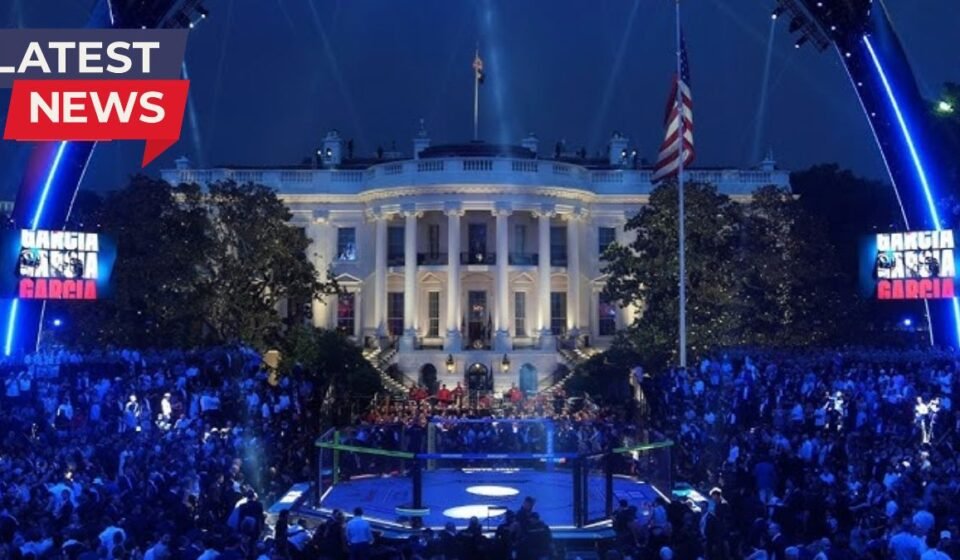
The target of the planned massacre was “Freedom 250,” an unprecedented, multi-million-dollar spectacle held on the White House South Lawn to mark the country’s 250th anniversary and President Donald Trump’s 80th birthday. According to court documents unveiled by the Department of Justice, the conspirators did not just aim to disrupt the historic sports broadcast; they actively plotted the assassinations of President Trump, Vice President JD Vance, prominent high-profile political and business figures including Elon Musk and Israeli Prime Minister Benjamin Netanyahu, alongside hundreds of regular spectators.
The unsealed federal indictment represents a massive effort by the U.S. government to consolidate multiple cross-country arrests into a single, comprehensive terrorism conspiracy prosecution. It details a chilling timeline of radicalization, digital tactical planning, and the physical stockpiling of weapons of mass destruction that began months before federal agents intervened just days ahead of the event.
Anatomy of the Plot
Federal prosecutors trace the origins of the conspiracy back to early May, when the group formed a highly organized network spanning several states, including Ohio, Missouri, Washington, Nebraska, West Virginia, and California. United by fringe conspiracy theories and a shared ideological desire to completely destabilize the United States government, the members set up structured, encrypted communication channels to build an operational plan.
Within their private online forums, the group operated under a rigid hierarchical structure. The indictment highlights that the participants categorized themselves into operational “tiers.” Those designated as “Tier 1” participants made explicit commitments to put themselves directly in harm’s way, violate federal laws, execute physical operations, and prepare to go into hiding as fugitives once the attack was completed.
As the weeks progressed, the group moved from ideological discussions to concrete logistics. Members began pooling financial resources and amassing a terrifying arsenal. Law enforcement subsequently recovered an array of combat gear, including tactical body armor, advanced communications equipment, specialized medical supplies intended for battlefield trauma, massive quantities of ammunition, and military-grade firearms. Crucially, the group also acquired commercial drones and raw explosives, focusing their efforts on converting the aerial vehicles into remotely piloted improvised explosive devices (IEDs).
To ensure the lethality of their planned operation, members of the group did not rely solely on digital coordination. Several co-conspirators met in person to engage in live-fire marksmanship exercises, tactical maneuver practice, and coordinated combat training designed specifically for the unique layout of the upcoming outdoor White House venue.
The Planned White House Massacre
The operational blueprint for the attack, as confessed by one of the detained defendants during FBI interrogations, was engineered to maximize human casualties and ensure maximum public terror.
The primary strike was designed to utilize the air. The group intended to pilot multiple explosive-rigged drones directly over the crowded South Lawn while the high-profile UFC matches were underway. The subsequent detonations were timed to kill high-value targets in the VIP sections and spark immediate, widespread panic among the hundreds of attendees packed into the temporary arena.
However, the aerial bombing was only the first phase of the assault. The group had allegedly established pre-positioned sniper nests outside the immediate perimeter of the White House complex. The indictment alleges that as the blast wave drove terrified, bleeding, and panicked crowd members to flee the venue toward the exits, the hidden snipers were ordered to open fire on the bottlenecked civilian choke points. By combining aerial explosives with coordinated ground sniper fire, the conspirators aimed to trigger an unprecedented domestic tragedy that would play out live on international television.
Interception and Cross-Country Arrests
The catastrophic plan was narrowly averted due to a breakthrough by federal counterterrorism investigators. On June 10—exactly four days before the UFC event was scheduled to take place on June 14—law enforcement intelligence agencies obtained actionable details regarding an active, imminent threat targeting the South Lawn spectacle.
The revelation triggered an immediate, high-stakes scramble by the FBI and joint terrorism task forces across the United States. Over the course of the weekend of the event, federal agents executed simultaneous raids across multiple time zones.
Among the initial wave of suspects caught in the dragnet was 19-year-old Tycen C. Proper of Danville, Ohio. Proper, identified as a central logistical figure who was actively traveling to facilitate the attack, was arrested alongside four other co-conspirators as they moved resources through Missouri, Nebraska, and California. Roughly one week later, as forensic analysts unraveled the group’s digital trails, the FBI tracked down and arrested two additional key suspects hiding out in Washington and Missouri.
The final piece of the initial operational cell fell into place when federal authorities tracked down 21-year-old Chandler D. Scaggs in Chapmanville, West Virginia. According to a federal affidavit, Scaggs was a critical asset assigned to act as one of the primary snipers in the operation.
Court records reveal that Scaggs was originally scheduled to be physically picked up by Proper and driven directly into Washington, D.C., to take up his sniper position. When Proper was quietly arrested by federal agents, Scaggs and the remaining cell members suddenly lost contact with him. Rather than abandoning the plot out of fear of exposure, Scaggs allegedly doubled down, signaling to the surviving members of the encrypted online group that he remained fully committed to carrying out the assassinations. He was actively arranging alternative travel accommodations with another undercover co-conspirator to reach the White House perimeter when the FBI took him into custody.
Legal Repercussions and Next Steps
The grand jury indictment returned in Columbus effectively replaces the patchwork of individual criminal complaints filed across various federal districts over the last month, consolidating the government’s case into a powerful, unified prosecution.
All eight defendants have been charged together under a strict two-count indictment. The first count charges all eight men with conspiracy to provide material support to terrorists, a federal offense that carries a maximum penalty of up to 15 years in federal prison. The second, far more severe count charges the group with conspiracy to commit murder on federal government territory and targeting a federal government official. A conviction on the murder conspiracy charge carries a maximum penalty of up to life imprisonment without the possibility of parole.
In the wake of the grand jury’s decision, Eric Brehm, the defense attorney representing Chandler Scaggs, issued a brief statement noting that his office is thoroughly reviewing the extensive federal allegations but declined to comment further on the specifics of the defense strategy.
While the “Freedom 250” UFC event ultimately proceeded under suffocating, highly visible security protocols, the chilling details contained in the indictment serve as a stark reminder of the evolving nature of domestic extremism. The integration of consumer drone technology with traditional tactical sniper operations represents a complex battlefield reality that law enforcement agencies are increasingly forced to confront on American soil. As the case moves toward a federal courtroom in Ohio, the eight defendants remain in federal custody awaiting trial.