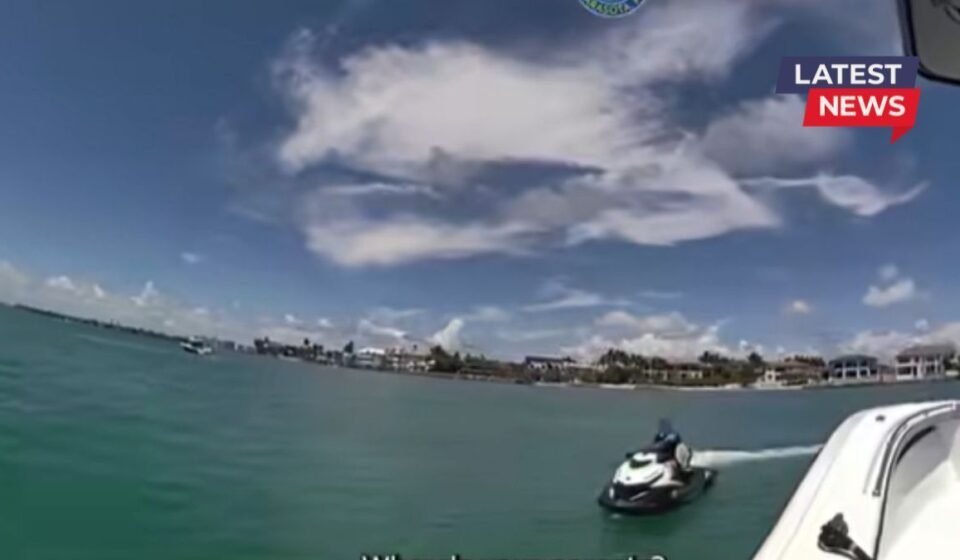
‘Where’s your parents?’: Dad busted for letting 8-year-old son drive a Jet Ski by himself, cops say

An afternoon on the water took a dramatic turn off the Gulf Coast of Florida when marine patrol officers spotted a lone figure handling a personal watercraft through rough coastal currents. What looked from a distance like an unusually small adult turned out to be an 8-year-old boy, completely unsupervised, operating a high-powered Jet Ski.
The incident, which occurred near Lido Key in Sarasota, Florida, has sparked nationwide conversations regarding maritime safety, parental oversight, and the growing trend of treating heavy, motorized recreational vehicles as toys for young children.
The Encounter: “Where’s Your Parents?”
On Sunday, June 14, 2026, during a busy weekend marked by choppy waters and heavy vessel traffic, officers with the Sarasota Police Department’s Marine Patrol Unit were surveying the waters off Lido Key. The area is a popular destination for tourists and boaters, known for its beautiful views but also its unpredictable coastal currents.
While patrolling, an officer noticed a personal watercraft (PWC) cruising across the waves. Upon drawing closer, the officer made a startling discovery: the operator was a young child who appeared entirely alone.
Bodycam footage later released by the Sarasota Police Department captured the astonishing interaction. The marine patrol officer pulled alongside the Jet Ski, looked down at the young boy, and asked a direct question:
The 8-year-old boy, wearing a life jacket but looking remarkably small behind the handlebars of the massive watercraft, pointed across the water toward the beach, indicating that his mother and father were ashore. The officer instructed the boy to slowly idle the watercraft back toward the beach so they could speak with his guardians.
The Confrontation on the Beach
Following the child back to the shoreline, the officer located the boy’s father. The subsequent conversation, captured on the police officer’s body camera, highlighted a stark disconnect between statutory safety regulations and parental justification.
When confronted by the marine patrol officer, the father immediately acknowledged that he suspected what he was doing crossed a legal boundary, though he attempted to minimize the gravity of the situation.
“Yeah, I’m sorry. I know that I really don’t think that he’s legal to drive, right?” the father can be heard saying on the footage. However, he quickly pivoted to defending his son’s capabilities, adding, “But we have been [riding] jet skis on the lake the last few years. He’s very proficient.”
The officer was quick to correct the assumption that past lake experience equated to safety in an open, crowded ocean environment. The officer noted that regardless of the child’s purported “proficiency,” the physical demands, unpredictable waves of the Gulf of Mexico, and crowded weekend traffic presented immediate hazards that an 8-year-old child is fundamentally unequipped to handle in an emergency.
The Legal Repercussions: Understanding Florida Boating Law
In the state of Florida—often considered the boating capital of the United States—the laws surrounding personal watercraft are clear and strictly enforced to prevent catastrophic accidents.
According to Florida law, it is a criminal violation to allow an underage operator behind the controls of a PWC. The baseline legal requirements state:
- Minimum Age to Operate: A person must be at least 14 years of age to operate a personal watercraft in Florida waters.
- Knowing Violations: It is illegal for a parent, guardian, or owner of a PWC to knowingly permit a person under the age of 14 to operate the watercraft.
- Criminal Status: Violating this law is classified as a second-degree misdemeanor.
Because the father knowingly allowed his 8-year-old son to take the Jet Ski out into the ocean alone, he was issued a criminal citation. He was not physically booked into a jail cell on the spot but was formally busted, charged, and given a mandatory notice to appear in a Sarasota County court. A second-degree misdemeanor in Florida carries penalties that can include up to 60 days in jail, probation, and a fine of up to $500.
The Hidden Dangers: Why “Proficiency” Isn’t Enough
The father’s defense—that his son was highly skilled from riding on flat lake water—is a common refrain heard by marine law enforcement officers across the country. However, maritime safety experts emphasize that operating a PWC requires far more than just knowing how to squeeze a throttle and turn the handlebars.
1. The Physics of Personal Watercraft
Modern Jet Skis are not small pool toys; they are high-performance marine vehicles. A standard modern PWC can weigh anywhere from 500 to over 1,000 pounds and routinely feature engines capable of reaching speeds between 50 and 70 miles per hour.
Importantly, personal watercraft require jet propulsion to steer. If an operator panics and completely lets go of the throttle, the watercraft loses almost all steering capability. An 8-year-old child lacks the weight, leverage, and cognitive development to handle a 900-pound machine traveling at high speeds if it begins to flip or slide out of control in rough coastal chop.
2. Cognitive Development and Split-Second Judgement
While an 8-year-old may possess the hand-eye coordination to steer a straight line on a calm lake, their brain development is not yet mature enough to handle complex risk assessment.
Off the coast of Lido Key, an operator must simultaneously monitor shifting wake patterns from larger boats, swimming pedestrians, hidden sandbars, changing tides, and other fast-moving vessels. If a larger boat unexpectedly crosses paths with a PWC, a young child does not possess the situational awareness or experience required to execute evasive maneuvers safely.
A Growing National Debate: Kids and Motorized Vehicles
The Sarasota incident has reignited a fierce online and community debate regarding where the line should be drawn regarding parental rights versus public safety. The story went viral on platforms like Reddit and YouTube, drawing thousands of comments from community members, boaters, and frustrated beachgoers.
Many residents pointed out that this problem extends far beyond the ocean. Across Florida and many coastal or suburban communities nationwide, there has been a noticeable surge in children operating motorized vehicles on public infrastructure.
The overriding consensus among safety advocates is clear: children may feel confident driving these machines, but confidence should never be confused with competence or legal compliance. When parents bypass laws under the guise of “parental discretion,” they put not only their own children at risk, but also the unsuspecting swimmers, kayakers, and boaters sharing the environment.
Summary of PWC Operational Guidelines
For those planning to hit the water, staying compliant with state maritime safety guidelines is essential for keeping everyone safe and avoiding a mandatory court date.
As summer crowds flock to the coast, law enforcement agencies like the Sarasota Police Department have made it clear that their marine units will maintain a zero-tolerance policy for underage operations. The ocean leaves incredibly thin margins for error, and as this Florida dad learned the hard way, a child’s “proficiency” will never override the law.